- You have no items in your shopping cart
- Continue Shopping

Finding the right bra size can feel confusing. Sizes vary between brands, styles change how a bra fits, and many of us were never taught how to measure properly in the first place. The good news: you can get a reliable starting point at home with a soft measuring tape and a few minutes of patience.
This guide walks you through how to measure your band size, bust size, and cup size—and what to do when the numbers do not match how a bra actually feels on your body.
What You Will Need
- A soft fabric measuring tape (not a stiff metal one from a toolbox)
- A mirror (helpful but not required)
- A well-fitting, unpadded bra or no bra at all—whichever reflects your natural shape more accurately
- A notepad or phone to write down your measurements
Measure in inches or centimeters, but stay consistent. Most bra sizing charts in the US and UK use inches.
Step 1: Measure Your Band Size
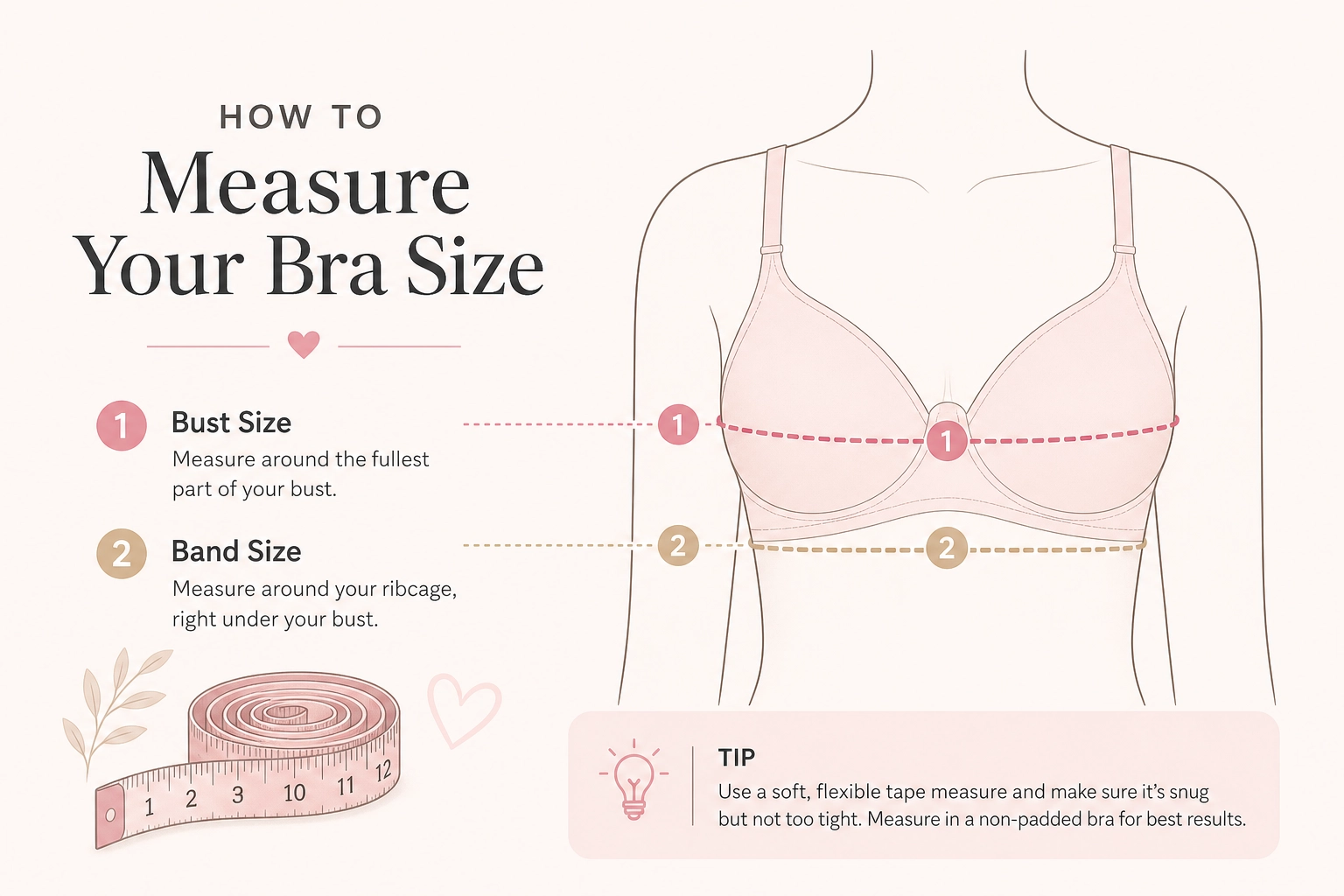
Your band size is the number in a bra size (for example, the 34 in 34C). It reflects the circumference of your ribcage, right under your bust.
- Stand upright with your arms relaxed at your sides.
- Wrap the tape around your torso directly under your bust, where the bra band sits.
- Keep the tape parallel to the floor all the way around—level in the front and back.
- Pull the tape snug but not tight. You should be able to breathe comfortably. It should not dig in or slide down.
- Round to the nearest whole number.
If your measurement is an even number, that is generally your band size.
If it is an odd number, try both the size below and above (for example, if you measure 31 inches, try 30 and 32 bands) and see which feels more secure without pinching.
Step 2: Measure Your Bust Size
Your bust measurement helps determine cup size.
- Wrap the tape around the fullest part of your bust, usually across the nipples.
- Again, keep the tape level around your body.
- Do not pull the tape tight—let it rest gently against your skin.
- Round to the nearest whole number.
Step 3: Calculate Your Cup Size
Cup size is the difference between your bust measurement and your band size.
| Difference (inches) | Cup Size |
|---|---|
| Less than 1 | AA |
| 1 | A |
| 2 | B |
| 3 | C |
| 4 | D |
| 5 | DD/E |
| 6 | DDD/F |
Each inch of difference typically equals one cup size, though naming conventions vary by region and brand.
Example: If your band size is 34 and your bust measures 37 inches, the difference is 3 inches—so your starting size is likely 34C.
Step 4: Try It On and Fine-Tune
Measurements give you a starting point, not a final answer. A bra should feel supportive and comfortable when you move.
Signs your band fits well
- It sits horizontal across your back—not riding up
- You can fit two fingers comfortably under the band at the side
- Most support comes from the band, not the straps
Signs your cups fit well
- Breast tissue is fully contained—no spillage over the top or sides
- No gaping at the top of the cup when you stand naturally
- The center gore (the piece between the cups) lies flat against your sternum in many styles
Common fit fixes
- Band rides up in back? Try a smaller band and go up one cup size to keep the same cup volume (sister sizing).
- Straps dig in? The band may be too loose—support should not depend on tight straps.
- Cups gape? Try a smaller cup or a different style (demi, full-coverage, balconette).
- Spillage? Try a larger cup or a style with more coverage.
Sister Sizing: Why 34C and 32D Feel Similar
Cup volume is not the same across all band sizes. A 34C and a 32D hold roughly the same cup volume—the band is just tighter on the 32.
If you change band size, adjust cup size in the opposite direction to keep similar volume:
- Down a band size → up a cup size (34C → 32D)
- Up a band size → down a cup size (34C → 36B)
This is useful when a bra almost fits but the band or cups are slightly off.
Tips for More Accurate Results
- Measure more than once. Take two or three readings and use the average.
- Measure at the same time of day. Swelling from activity, heat, or hormonal changes can affect bust size slightly.
- Check your size periodically. Weight changes, pregnancy, surgery, and aging can all shift your measurements.
- Try different styles. A balconette, plunge, and full-coverage bra in the same size can fit very differently.
- Do not chase one “correct” size. Brand sizing varies. Focus on fit, not the label.
When to Get a Professional Fitting
A home measurement works well for most people, but consider a professional fitting if:
- You are between sizes and cannot get either to feel right
- You have had a significant body change recently
- You need a specialty size or adaptive bra
- You experience pain, digging, or skin irritation from bras
Many lingerie shops and department stores offer free fittings. A good fitter will measure you and also assess how specific bras sit on your body.
Final Thoughts
Measuring your bra size at home is straightforward: measure snugly under the bust for your band, gently around the fullest part of the bust for your cup calculation, then try bras in that size and adjust based on feel. The tape measure gets you close; the mirror and a few minutes of movement tell you whether you have found the right fit.
Comfort and support matter more than any number on a tag. Use this guide as a starting point, trust what you feel when you wear the bra, and do not hesitate to explore sister sizes or different styles until everything sits just right.